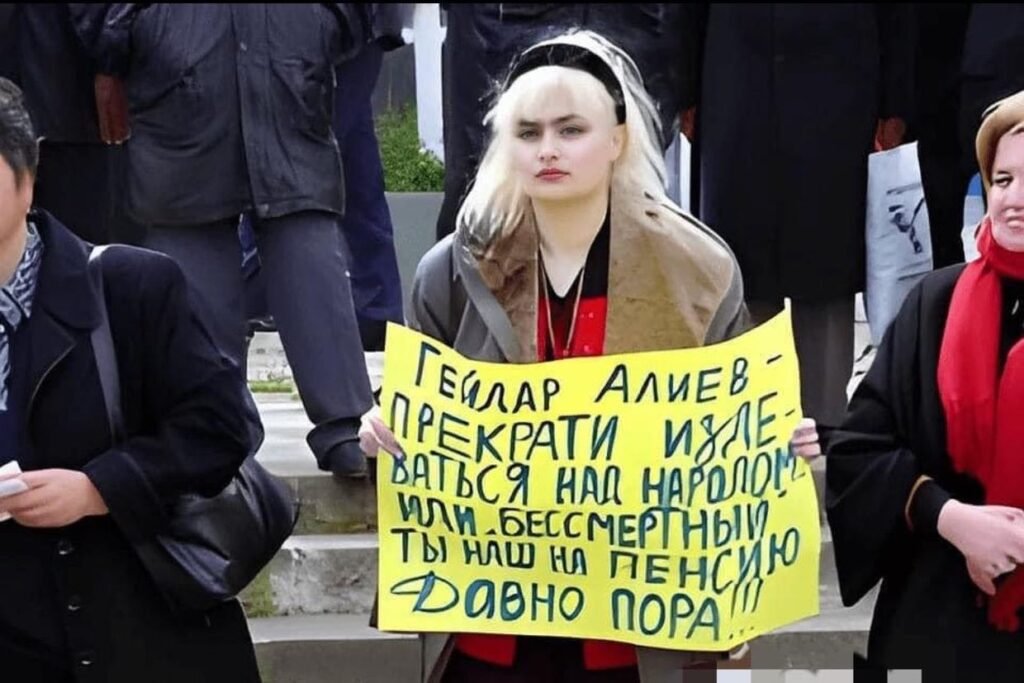
Faina Kungurova, who was born on 18 October 1974, became part of one of the darkest chapters in Azerbaijan’s history of repression. Her official name was Farida. She was only 33 when she died in prison on 18 November 2007 while on a hunger strike. The circumstances surrounding her death remain unclear to this day.
Faina was born in Baku. Her father was Azerbaijani and her mother was Jewish. One of the attacks directed at Faina by the government was the attempt by officials to tell the public that her mother was Armenian, not Jewish. In this way, false information was spread to portray her as a member of an enemy nation who did not deserve to be defended.
Over the years, Faina began to be remembered more often by the country’s civil society activists and dissidents. In June this year, a group of imprisoned journalists, civil society activists and political activists declared 18 November, the date of her death, Azerbaijan’s Political Prisoners Day. The statement announcing this was signed by Aytaj Tapdig, Khayala Aghayeva, Aysel Umudova, Aynur Elgunash, Shamshad Agha, Ulvi Hasanli, Nargiz Absalamova, Elnara Gasimova, Hafiz Babali, Natig Javadli, Sevinj Vagifgizi, Ramin Deko, Ramil Babayev, Akif Gurbanov, Nurlan Libre, Mammad Alpay, Rufat Safarov, Ilkin Amrahov, Fatima Movlamli, Mushvig Jabbar, Ali Zeynal, Ulviyya Guliyeva, Ruslan Izzatli, Farid Ismayilov, Afiyaddin Mammadov, Bahruz Samadov and Imran Aliyev.
At the time of her death, Faina was serving her second period as a political prisoner. She was first arrested on 24 April 2001 and sentenced to three years in prison. After spending two years in detention, she was released. During this period, the Council of Europe recognised her as Azerbaijan’s first female political prisoner. Faina was arrested for the last time on 5 October 2007.
She died 44 days after this second arrest. Following her detention, Faina was placed in the Shuvalan Pre-trial Detention Centre. Before her death, she was transferred to the Penitentiary Service’s Treatment Institution. Her relatives said that although she died on 18 November, they were informed by telegram only on 21 November. Her family considered her death suspicious and reported that, when examining Faina’s body, they had seen fresh needle marks on her arm, which shocked them. This further deepened the mystery surrounding whether she had died of natural causes or had been killed. Her family also said that “her face had a tortured, painful expression on it”.
Faina had a 13-year-old daughter when she died.